Skip to product information
Vanadium Redox Flow Cell (Single Split Unit) for Battery R&D - VRB-C-LD

Vanadium Redox Flow Cell (Single Split Unit) for Battery R&D - VRB-C-LD

SKU: vrb-c-ld

Price: RFQ

Specifications

VRB-C is a splittable single unit flow cell for Vanadium Redox Flow Battery research; a battery technology that takes advantage of eliminating the use of rare earth metals. Most importantly, this battery kind holds the potential to be vastly scaled up for industrial applications while incurring a lower cost increase -- the storage capacity is scaled up by implementing a larger electrolyte storage tank (compared to lithium-ion cells in which the number of active materials on electrodes need to be increased and are more costly to produce). Moreover, this type of battery is capable of being charged and discharged for over 10 times the life cycle of lithium-ion cells with no capacity loss. This split test cell features easy and fast assembly with convenient part replacement to facilitate research for flow cell cathode and electrolyte solutions. SPECIFICATIONS Features: Single cell voltage range: 1.2V ~ 1.6V (depending on Vanadium electrolyte composition) Cell current density: 40 ~ 100 mA / cm^2 ( maximum 4.9A of possible current draw for a 7cm x 7cm reactive area) Manifold Blocks are made of anti-corrosive PTFE materials to withstand acids The large reactive area provides uniform and reliable test data Cathode materials are changeable according to the test conditions Easy assembly and disassembly Reactive Area - Multiple Configurations Standard cell comes with 3 interchangeable frames and gaskets for testing multiple parameters (please click the bottom left picture below for details): 7x7cm 5x5cm 3x3 cm Custom reactive area sizes up to 7cm x 7cm can be requested at an extra cost Compression Pressure 87 PSI (0.6Mpa), ~300KG Force is recommended 116 PSI (0.8Mpa) Max. Unit Cell Internal Structure (all components are included) All components, Manifold Blocks, Current Plates, Bipolar Plates, Gaskets, Frames, Carbon Felts, Membranes, O-Rings, liquid inlet, and outlet ports, are included for immediate use. Please click here to order extra Internal Components if it is needed. Bipolar Plates High electrical conductivty, chemical resistance, and high mechanical strength for toughness These highly flexible plates offer performance comparable to conventional graphite plates BUT have excellent resistance to breakage and have fewer defects Only ~0.7mm in thickness, this keeps cells thinner when stacked compared to graphite plates ( porous and brittle in nature; needs to be thick structurally) Needs frequent replacement, please order from the "Related Products" category below Application Notes Vanadium Redox Flow Cell Sketch Photo Credit: Rahman, F.; Skyllas-Kazacos, M. Vanadium redox battery: Positive half-cell electrolyte studies. J. Power Sources 2009, 189, 1212-1219. Procedure for Testing Flow Cell -- click the picture to enlarge: MTI provides the complete setup at an affordable cost for the entire testing procedure. Please see images or related products below for more details. A jig or pressing machine is required to tightly press the cell together in order to suppress leakage of electrolyte solutions during live tests and also decrease ion/electron resistance. Please order a hydraulic jig separately form below or use your own jig -- WARNING : Never exceed a maximum pressure of 0.8MPa to avoid damage to the flow cell Peristaltic pump and battery analyzer are also available for making a low-cost DIY Flow Battery test system (please choose from related products below). Relevant Articles & Videos Relevant Articles & Publications (click for links): "Vanadium Redox Battery" from http://www.vanadium-redox-battery.com/ "Membranes for Redox Flow Battery Applications" Published: 19 June 2012 "A Review of Metallic Bipolar Plates for Proton Exchange Membrane Fuel Cells: Materials and Fabrication Methods" Accepted: 13 June 2012 Videos (click to Watch): A. HOW THE VANADIUM REDOX BATTERY (VRB) WORKS video credit: VanadiumCorp Resource Inc. B. Making a vanadium redox flow battery, video credit : Energy Storage CDT (University of Southampton) C. Video by MTI showing the Flow Cell in operation Optional Accessory For a convenient electrolyte delivery to the flow cell, the anti-corrosive tanks feature easy tube connectors and can be seated onto a jig to prevent from falling over. Please click here to learn more on the product page

Features:
  • Single cell voltage range: 1.2V ~ 1.6V (depending on Vanadium electrolyte composition)
  • Cell current density: 40 ~ 100 mA / cm^2 ( maximum 4.9A of possible current draw for a 7cm x 7cm reactive area)
  • Manifold Blocks are made of anti-corrosive PTFE materials to withstand acids
  • The large reactive area provides uniform and reliable test data
  • Cathode materials are changeable according to the test conditions
  • Easy assembly and disassembly
Reactive Area - Multiple Configurations
  • Standard cell comes with 3 interchangeable frames and gaskets for testing multiple parameters (please click the bottom left picture below for details): 
    • 7x7cm
    • 5x5cm
    • 3x3 cm
  • Custom reactive area sizes up to 7cm x 7cm can be requested at an extra cost
Compression Pressure
  • 87 PSI (0.6Mpa), ~300KG Force is recommended
  • 116 PSI (0.8Mpa) Max.
Unit Cell Internal Structure (all components are included)
All components, Manifold Blocks, Current Plates, Bipolar Plates, Gaskets, Frames, Carbon Felts, Membranes, O-Rings, liquid inlet, and outlet ports, are included for immediate use. Please click here to order extra Internal Components if it is needed.
   
Bipolar Plates
  • High electrical conductivty, chemical resistance, and high mechanical strength for toughness
  • These highly flexible plates offer performance comparable to conventional graphite plates BUT have excellent resistance to breakage and have fewer defects
  • Only ~0.7mm in thickness, this keeps cells thinner when stacked compared to graphite plates ( porous and brittle in nature; needs to be thick structurally)
  • Needs frequent replacement, please order from the "Related Products" category below

Application Notes


Vanadium Redox Flow Cell Sketch

Photo Credit: Rahman, F.; Skyllas-Kazacos, M. Vanadium redox battery: Positive half-cell electrolyte studies. J. Power Sources 2009, 189, 1212-1219.

Procedure for Testing Flow Cell -- click the picture to enlarge:
MTI provides the complete setup at an affordable cost for the entire testing procedure. Please see images or related products below for more details.
  • A jig or pressing machine is required to tightly press the cell together in order to suppress leakage of electrolyte solutions during live tests and also decrease ion/electron resistance. Please order a hydraulic jig separately form below or use your own jig -- WARNING: Never exceed a maximum pressure of 0.8MPa to avoid damage to the flow cell
  • Peristaltic pump and battery analyzer are also available for making a low-cost DIY Flow Battery test system (please choose from related products below).
                   
Relevant Articles & Videos Relevant Articles & Publications (click for links):
  1. "Vanadium Redox Battery" from http://www.vanadium-redox-battery.com/
  2. "Membranes for Redox Flow Battery Applications" Published: 19 June 2012
  3. "A Review of Metallic Bipolar Plates for Proton Exchange Membrane Fuel Cells: Materials and Fabrication Methods" Accepted: 13 June 2012
Videos (click to Watch):
A. HOW THE VANADIUM REDOX BATTERY (VRB) WORKS video credit: VanadiumCorp Resource Inc.
B. Making a vanadium redox flow battery, video credit: Energy Storage CDT (University of Southampton)
C. Video by MTI showing the Flow Cell in operation
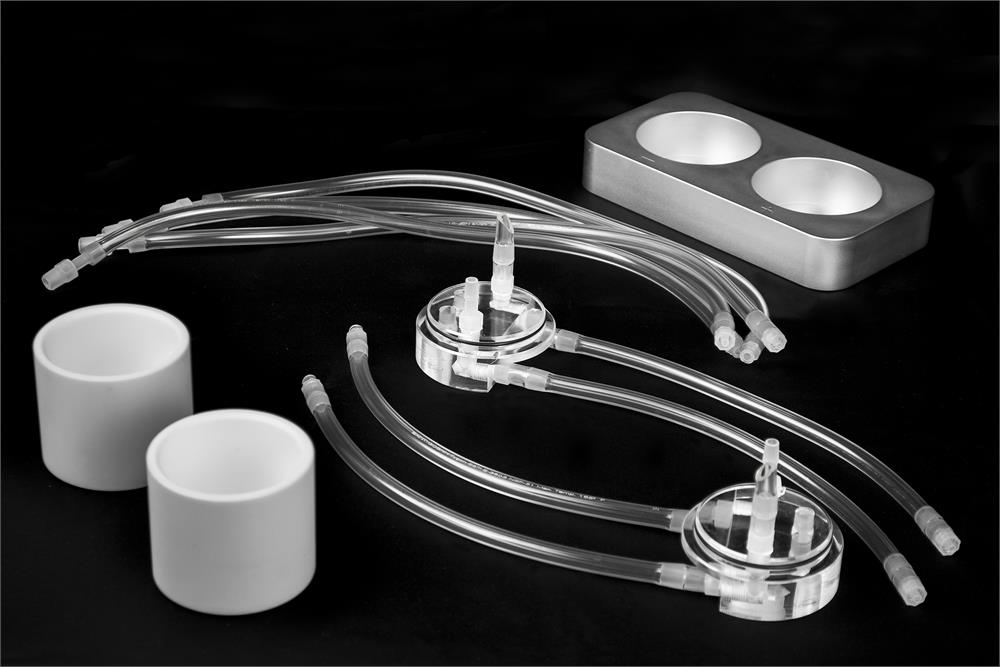
Optional Accessory                  

You might also like...