|
Power
|
|
|
Effective Cylinder Width
|
|
| Roller Size |
|
|
Product Thickness
|
|
|
Dial Gauge Accuracy
|
- 0.01mm
- Optional: A digital micrometer is available at an extra cost
- Resolution: 0.001mm
- Manual adjustment for rolling gap
-
|
| Minimum Thickness |
Depending on the electrode's material and thickness, typically:
- A 0.16mm thick electrode coated on copper can be pressed into a minimum thickness of 0.1 mm
- A 0.06mm thick electrode coated on copper can be pressed into a minimum thickness of 0.04 mm
- A 0.33mm thick silver/gold can be pressed into a minimum thickness of 0.03 mm
|
Temperature Control
|
- Two independent temperature controllers enable dual-zone temperature control for the front and rear rollers.
- Temperature range: RT - 200°C
- Temperature accuracy +/-5°C
- Max heating temp: 200°C < 1.5 hour
- Continuous heating temp: 190°C
- Two heating elements are installed
- Power of each Heating Element: 500 Watts
- The heating rod is aconsumable. Please click picture left to order replacment
|
|
Heating Rate
|
- RT-100°C: ~3°C/min
- 100-150°C: ~2.5°C/min
- 150-200°C: 1~2°C/min
|
|
Gravity-Feed Design
|
- Two rollers are aligned horizontally and supported by the steel frame. Such a design allows users to gravity-feed flexible materials front above the rollers and collects at the bottom. (Pic. 1)
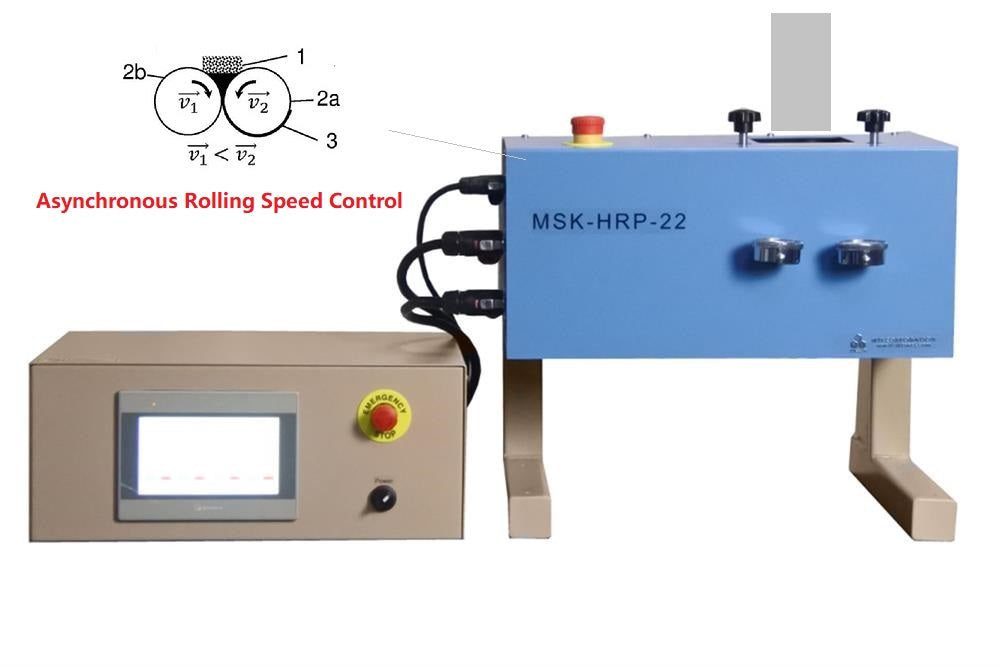
- Independent speed control is available upon request at the extra cost. (Pic. 2)
(Pic. 1) (Pic. 2) |
|
Motor
|
- High torque 24VDC motor with reducing gear
- 0.8A
- Rated power 40W
- Speed Indicator Display: 0~26 mm/s (real linear speed of rollers)
- Digital controlled with constant output power
|
|
Surface Hardness of Rollers
|
- HRC 52
- Warning: Never roll materials with hardness >40HRC because rollers are softened in 200.
- Note: Benchtop rolling press is not suitable for calendaring thick metals. For applications with such needs, please consult with MTI engineers.
|
|
Application Notes
|
Important announcement (please read this before place the order)
- The MSK-HRP-02 roller is specially designed for battery R&D in terms of its advantages as affordable, compact, and precise. Please strictly follow the instructions to operate
- Must use acetone to clean rollers' surface after each use
- Never rolling material with hardness > 50HRC
- If the machine will be idle for a long period of time, please apply anti-rust lubricant on the rollers
- The minimum thickness of the rolled sheet should depend on the physical property of the material. Here are some results from our test:
- Please refer to this instruction on how to calculate rolling pressure from roller gap (reference only)
| Electrode |
Size |
Original thickness |
Finished thickness |
| LiFePO4 double sides |
50mm Width x 260mm Length |
0.205mm |
0.09mm |
| LiMn2O4 double sides |
50mm Width x 260mm Length |
0.205mm |
0.09mm |
| Copper foil + graphite (single side) |
75mm Width x 240mm Length |
0.09mm |
0.04mm |
|
Compliance |
- CE Certified
- NRTL or CSA certificate is available upon request at extra cost.
|
| Article |
|
| Warnings |
- Never roll materials with hardness > 50HRC
- The rolling machine can be used in the Ar gas environment.
- To prolong the lifespan of the roller bearings, regular lubrication is recommended.
- Multi-step thickness calendering needed: While calendering the sample sheet, make each calendering decrement of 0.02mm compared with the sheet's original thickness.
- Never calendering decrement over 0.02mm compared with original sheet thickness each calendering.
- Clean the roller surface before and after each rolling process. Lubricate the roller surface when the machine is planned for idle to avoid corrosion.
- It is not allowed to use any MTI product in any hazardous location, especially prohibited from using in Class I environments (flammable gasses & vapor).
|